The most common compensators are made of rubber, PTFE or steel, materials chosen to withstand different temperatures, pressures, chemicals and operating conditions.
What movements does a compensator compensate for?
In pipe systems, several types of movements and forces arise. Compensators are used to absorb these to avoid material fatigue, leakage and damage.
Axial forces
Longitudinal movements in the direction of the pipe, for example during thermal expansion when pipes heat up and become longer.
Radial Forces
Movements that go sideways straight out from the center line of the pipes, usually caused by pressure changes or miscentering.
Angular forces
Twisting or bending of pipe segments where the pipes are not exactly at the same angle, for example during installation or settlement.
Lateral pipe forces
Lateral displacements where the entire length of pipe moves parallel to the side, for example in the event of vibration or mechanical influence.
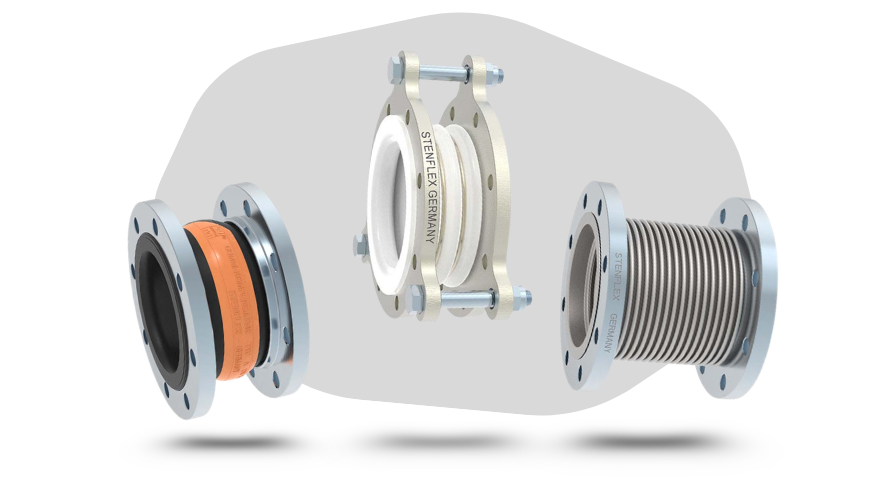
Product Overview
Our compensators and swivels
Below is a summary of our range, broken down by type and application.
Rubber Compensators
AL 84-A-1/2/4
A robust rubber compensator with vulcanized rubber bellows reinforced with textile cord. The flanges are designed with relieving collars that optimize the life of the bellows.
Application:
Suitable for both simple and more demanding industrial installations. Compensates for axial, radial, angular and lateral movements. Effective for dampening vibrations and noise from pumps and machines. Resistant to pressure, vacuum, aggressive and neutral liquids and gases.
AL 84-SAE
A rubber compensator with textile cord-reinforced bellows and rotatable SAE flanges. Features a wire-reinforced, self-sealing rubber edge for extra secure sealing. The AL-84-SAE is made of aluminum, which provides low weight and good corrosion resistance, and is particularly suitable for hydraulic applications up to 3000 psi.
Application:
For hydraulic and industrial environments where the same types of piping forces need to be compensated. Suitable for both aggressive and neutral media.
PTFE Compensators
AL 84-AI
PTFE Lined Compensator Reinforced with Synthetic Cords and Equipped with Rotating Flanges.
Application:
Used in demanding environments with high chemical requirements. Compensates for all types of movement and dampens vibrations. The PTFE lining provides very good resistance to most acids and alkalis.
AL 84-P
A PTFE compensator with bellows of homogeneous PTFE and rotating flanges.
Application:
Ideal for processes with aggressive liquids and gases such as acids, bases, solvents, peroxide, fuels, etc. Compensates for all types of piping forces and dampens vibration and noise.
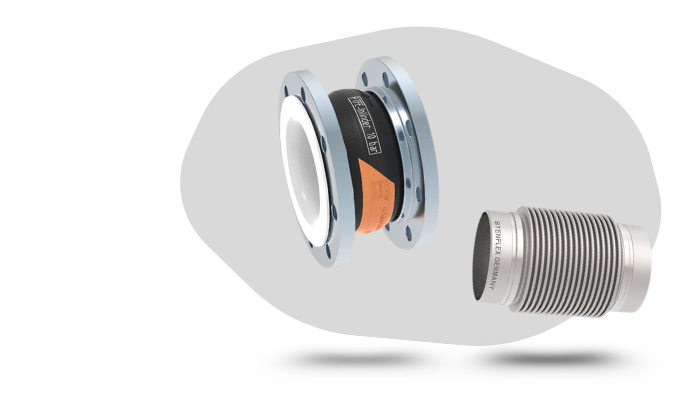
Steel compensators
AL 85-SA10
A compensator with stainless steel bellows and carbon steel welding ends, designed to handle axial movements.
Application:
Adapted for high temperature systems where axial compensation is required. Reduces stress, vibration and noise in piping systems for both gases and liquids.
All these products are manufactured by German Stenflex.
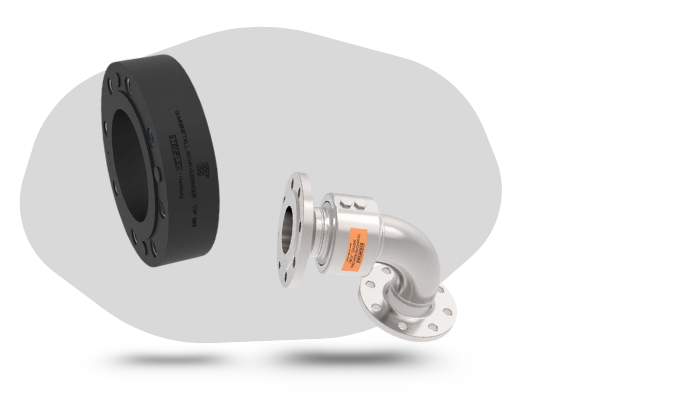
More from Stenflex
Vibration dampers
AL 86-GRV
A nitrile rubber vibration damper with invulcanized, separated steel flanges. The smooth interior ensures minimal flow resistance.
Application:
For the dampening of sound and vibration in piping systems, especially at pumps, regulators and machines.
Swivels
AL 86-D
A robust swivel for rotating pipe connections in pressurized systems. Factory lubricated for long life.
Application:
Used to absorb twisting movements and allow for full rotations at low speed. Can also be used in two- or three-joint systems to handle larger movements. Transports media from fixed to flexible points in piping systems.