What happens when a valve package is automated?
The difference between a manual and an automated solution lies in how the valve is controlled. Instead of opening or closing the valve by hand, a signal is sent from a control system. It can be an electrical signal or compressed air, depending on the type of actuator used.
This means that Valve assembly can be integrated into larger systems and react directly to changes in the process, for example in the event of pressure changes or the need to start and stop flows.
How to control the flow step by step
To understand how an automated valve assembly works, you can break it down into a few simple steps.
- A signal is sent from a control system, such as a PLC system or a simple control panel.
- The signal activates the actuator, either via electricity or compressed air.
- The actuator converts the signal into a mechanical movement.
- The valve opens or closes, which regulates the flow in the system.
The entire process takes place quickly and controlled, which means that the process can be controlled with high precision.
How do different types of actuators work?
The choice of actuator affects how the valve package works in practice.
Pneumatic actuators, such as AL 77 and AL 79, powered by compressed air and often used where fast and frequent operation is important. Within Axel Larsson's valve assemblies, the AL 77 is used with the Scotch Yoke principle, which provides extra torque at the beginning and end of the movement, while the AL 79 works with a linear torque.
Electric actuators, such as the AL 78, are instead controlled by an electrical signal. They are often self-inhibiting and can hold their position even in the event of a power failure, making them suitable for systems where stable positioning is important. This type of solution is often used in valve assemblies where precise control and positioning are essential.
What components work together in an automated valve assembly?
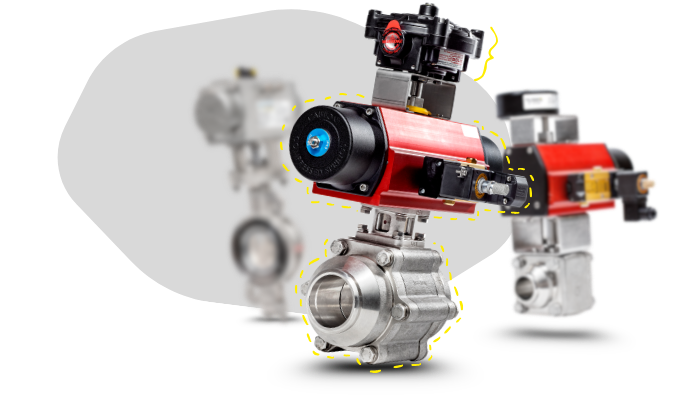
An automated valve assembly consists of several parts that work together:
- The valve, which controls the flow itself
- The actuator, which opens and closes the valve
- Solenoid valves or control signals, which activate the actuator
- Position indicator or positioner, which shows the position of the valve
When these components are properly combined, you get a solution that is both reliable and easy to integrate into piping systems.
Why are automated valve packages used?
Automated valve packages are used in everything from simple installations to advanced industrial processes. They make it possible to control flows automatically, reducing the need for manual handling and increasing both safety and efficiency.
In many businesses, this is a prerequisite for being able to work with continuous processes where flows need to be regulated quickly and precisely.
Need help finding the right solution?
Automated valve assemblies can be adapted to both simple and more advanced needs. By combining the right valve, actuator and accessories, you get a solution that works optimally in your plant.
At Axel Larsson, we have extensive experience in combining and assembling valve assemblies in different configurations, from standard solutions to more complex systems. Contact us and we will help you develop a valve package that suits your application.