What is a valve assembly and why do you choose it?
A valve assembly is a complete assembly in which the valve, actuator and accessories are assembled and tested together. Instead of buying each component separately, you get a ready-to-install solution.
For many companies, it is also reassuring to know that the valve and the diffuser are adapted for each other from the start.
What media and pressure do you work with?
The first question to ask is which media should be controlled. Is it a liquid, gas or vapor? Different media affect both the material of the valve and the seal that should be used.
For example, water in a heating system may have different requirements than pressurized gas in an industrial process. Steam means higher temperatures that affect both valve bodies and seats. If you work with aggressive media, special material choices may be required to avoid wear and tear over time.
The pressure is at least as important. A valve package that works well in a low-pressure application is not the right choice in a system with higher differential pressures. In larger dimensions or at higher pressures, the torque requirement increases, which affects the choice of actuator.
If the valve is to open and close at high pressure, a higher torque actuator may be required, especially in combination with ball valves or butterfly valves. For good function, it is important that the valve and the diffuser are dimensioned together.
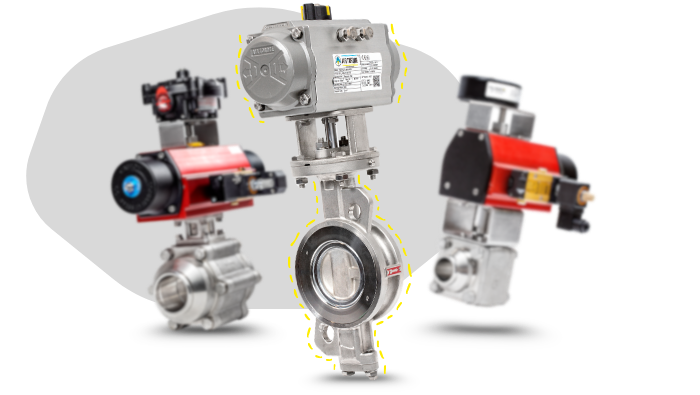
Pneumatic or electric actuator?
A common question is whether to choose a pneumatic or electric valve package.
Pneumatic valve assemblies are often used where compressed air is already available and where quick operation is important. They are common in industrial environments where valves open and close frequently.
Electric actuators are suitable when you want control via electrical systems and clear position control. In buildings or facilities where compressed air is lacking, electrical solutions are often a natural choice.
The choice is usually based on how the facility is structured and how the control should take place.
Environment and installation conditions
Also consider where the valve package will be installed. Should it be placed outdoors, in a humid environment or in an area with special classifications?
Temperature, environment and available space affect both valve type and choice of diffuser. In some industries, regulations such as PED or ATEX also need to be taken into account. Here it is important that the entire valve package is adapted to the environment in which it will be working.
When is a custom valve assembly the right choice?
Standard solutions work in many cases, but sometimes a more customized configuration is required. This can be special connections, special materials or integrated accessories such as solenoid valves and positioners.
Getting help early in the process can avoid unnecessary adjustments later.
Need help choosing the right valve assembly?
Choosing the right valve assembly is about weighing up media, pressure, control and environment. If you are unsure, it is often easier to discuss the requirements before you decide.
Axel Larsson has worked with valves with diffusers for over 70 years and installs thousands of valve assemblies every year. Our range includes both pneumatic and electrical solutions as well as several types of valves that can be combined as required.
Whether it's a simple installation or a more complex process, we can help you develop a valve package that is tailored to your application. Contact us and we will go through your conditions together.